“Random encounters with the unusual” is a repository for the oddities that me and Mrs J have encountered on our travels, which we find interesting or amusing in some way. Have a look, maybe you will find something interesting or amusing herein.

Wednesday, 2 July 2014

The Durham Dwarf

The portrait below shows a man called Józef Boruwlaski. Boruwlaski was a diminutive entertainer who was born in Poland in 1739 into a family that ultimately consisted of 6 children, three of whom were unusually small. Boruwlaski was said to have been 64cm tall at 15 years old, 71cm at 22 years old, 89cm at 25 years old and finally reaching his maximum height of 99cm by the age 30. One of Boruwlaski’s elder brothers was reported to have been only a few centimetres taller than him, and his sister who was three years his junior, was reported to have been only 66cm in height (whether this was her ultimate height is unclear). However, it seems that Boruwlaski’s other three siblings were of a more normal stature, and he even had one brother who grew to be six feet and four inches in height. Boruwlaski and his two vertically challenged siblings may have been of a small size but they were also said to have been built in proportion to their height and to not have suffered any of the deformations or disabilities associated with typical dwarfism.

Boruwlaski's small stature gave him the problem of finding a suitable way to make a living, and many potential avenues of employment such as the clergy or military service were out of the question given his physique. This predicament led him to look for a wealthy sponsor and he eventually became adopted by The Starostin de Caorlix, and was then subsequently taken into the care of Countess Humiecka. This adoption kicked off Boruwlaski’s career as an entertainer and curiosity for European high society, a career that saw him touring Europe and meeting such influential people as the Queen of Hungary, the King of Poland, the King of England and the Queen of France. Even though Boruwlaski mingled with such important people, his real purpose was to essentially be an interesting diversion for the courts of the day and his travels saw him being taught to dance and play the guitar by some of the best professionals of the day. He was also often made to dress up in small copies of military uniforms and sometimes even posed in purpose built miniature doll’s houses. Some people may have classed Boruwlaski as a sideshow freak, and it must have been an interesting sight when he met a couple of prominent sideshow freaks of the era. He met Patrick Cotter (The Irish Giant) a man who stood 8 feet tall, and he also met the famously obese Daniel Lambert, who in his prime weighed in at massive 50 stone.

As Boruwlaski’s touring career came to an end he needed to find a new way to make a living. His later years saw him trying to make a living for himself and his wife (a woman of normal stature) from playing music, and eventually he had to resort to displaying himself in public and writing an autobiography to try to make ends meet. Eventually however, an organist of Durham Cathedral (Thomas Ebdon) offered Boruwlaski  a place to live, and Boruwlaski lived out his days in Banks Cottage in the company of the unmarried daughters of Thomas Ebdon. Boruwlaski eventually died in Durham in 1837 at the grand old age of 98.

It seems that the city of Durham fondly remembers its diminutive Polish resident and clues to his time in Durham can be found in a number of places. Durham Town Hall is home to a life-sized statue of Boruwlaski, as well as an oil painting of Boruwlaski as an old man. There is also a display of some of his personal effects, which includes a suit, hat, cane, chair and violin.

Durham Cathedral is also home to a tribute to Boruwlaski, his tombstone. Just inside the entrance to the cathedral on the right hand side a small stone slab (approximately 15cm x 15cm square) can be found set into the floor bearing the initials “J B”. It seems that Boruwlaski was interred in the cathedral, close to one of his influential friends (Stephen Kemble).

Following the riverside footpath that skirts the peninsular on which the cathedral resides brings the walker to a riverside folly. The folly is a mock Greek temple which is referred to locally as The Count’s House. It seems that during his touring days Boruwlaski used the title Count Boruwlaski, even though he had no formal right to the title, and as such, people incorrectly assume that the folly is where Boruwlaski once lived. The truth is less exciting however, and it seems that the folly was probably just an ornamental feature in the garden of the property where Boruwlaski saw out his retirement years.

For any readers who are interested in the Count’s life and travels a version of his autobiography can be found here.

A portrait of an elderly Józef Boruwlaski in Durham Town Hall.
A life size Józef Boruwlaski in Durham Town Hall.
A collection of Józef Boruwlaski's possessions in Durham Town Hall.


Durham Cathedral.
Józef Boruwlaski's tombstone inside Durham Cathedral.
The Durham folly known as The Count's House.


Inside The Count's House.

Pictures, County Durham (June 2014).

If you find this post interesting please share it using the buttons below.

Tuesday, 24 June 2014

Maintaining the Broad Town White Horse

On the sunny weekend of the 14th & 15th of June, Mrs J had the pleasure of helping a team of local volunteers to refurbish the white horse that overlooks the village of Broad Town in Wiltshire.

The Broad Town White Horse (which I have previously mentioned in my “An Armchair Tour of Britain's White Horses”) is situated about half a mile northeast of Broad Town and is believed to date from 1864.

The Broad Town White Horse as seen from Google Maps.
The Broad Town White Horse in 1947.
So armed with a variety of gardening implements the team of volunteers from the village of Broad Town, led by local Archaeologist Bob Clarke, set off to restore the white horse. The first day of activities saw the team spend most of their time weeding the horse and trimming the horse’s outline. It seems that because the field in which the white horse is situated is not grazed by livestock that the outline of the horse is constantly under threat of becoming over grown. This unrelenting march of nature means that twice a year the horse has to be weeded and trimmed to ensure that it retains its shape and its crisp outline, otherwise after a few short years it would be lost from view. 

The Broad Town White Horse on day 1, before its make over.
Zooming it - it's not really white any more.
The horse's head - it is overgrown and the home to weeds.
The rear part of the body and the two back legs - after some weed clearing has occurred.
The body of the horse - almost clear of weeds.
The arch of the horse's back restored to a nice sharp line with the tail, yet to be weeded at the back. 
The restoration team at the start of day 1 (excluding Team Leader Bob Clarke, who is behind the camera).
Day two saw the team complete the weeding and edging activities. Once the team had finished removing all the weeds from the horse’s body and had restored its eye, body and limbs to their nature shape and size, attention turned to restoring the horse back to its natural white colour.

Originally when the white horse was cut into the hillside chalk it would have appeared a brilliant white, however over time the colour tends to yellow and on an annual basis the volunteers have to re-lime the horse to ensure it retains its former glory. Coating the Broad Town White Horse in lime required the use of over 1 tonne of powdered lime, which the team raked out over the horse’s body and limbs to give the horse a restored brilliant white appearance. As it was explained to me, once the first rains hit this powdered lime, it turns from a fine powder into a hard crust and gives the horse another year of life.

The Broad Town White Horse only seems to survive due to the dedication of the local villagers who commit a few days each year to its upkeep. The villagers also have to fund the work themselves, raising money during community events. Interestingly, the Broad Town White Horse is not a scheduled ancient monument and if it did become so it sounds like it would prevent the villagers from taking care of it in such a cost efficient and proactive manner.

Bags of powdered lime starting to be laid out.
All the bags laid out.
The leader of the restoration (Bob Clarke) opens the first bag of lime on the horses head.
The new white lime in comparison to the old (non-white) surface.
The restoration team at the end of day 2 (excluding Mrs J, who is behind the camera).
It should be noted that I only turned up to take a few photos late on day 2 - I did not really get involved in the hard work!
The restored horse seen from the track just below the hill.
Zooming in.
The restored Broad Town White Horse seen from the village school. 
Zooming in.
The information board that lives just below the horse.

On my way home from the Broad Town White Horse I also happened to pass another local white horse, The Broad Hinton White Horse. The Board Hinton White Horse (also known as the Hackpen White Horse) lies about two miles southeast of the village of Broad Hinton (on the side of the B4041). Details of the origin of this white horse are not certain, but some believe it was cut into the hillside in the mid 1800’s (possibly in 1838 to commemorate the coronation of Queen Victoria). It also seems that the local area used to be home to a third white horse at Rockley (between Hackpen and Marlborough), which was rediscovered in 1948 on land at Wick Down Farm on Rockley Down, but subsequently lost again to the farmers crops and plough. From the design of the horse it has been proposed that it dates from the early 19th Century, which neatly aligns with the dates of the creation of the Broad Town and Hackpen horses - clearly creating white horses in Wiltshire in the 19th Century was the fashionable thing to do!

The Hackpen White Horse.
The Hackpen (Broad Hinton) White Horse as seen from Google Maps.
The Rockley Down White Horse, reproduced from: The Wiltshire Archaeological and Natural History Magazine,  Volume 59, 1964. 
Pictures, Wiltshire (June 2014).

If you find this post interesting please share it using the buttons below.

Tuesday, 17 June 2014

Beacon Hill and the Mummy's Curse

The views below are from the top of Beacon Hill in Hampshire, which can be found alongside the A34 near to the village of Burghclere. The hill derives its name from the fact that it was once used as the site of one of Hampshire’s many signalling beacons. The hill is 261 metres high and is the remains of an Iron Age hill fort, with some of the old earthworks still visible today. The fort at Beacon Hill is estimated to have been built around 1000 BC and is believed to have been a significant fort, being home to around 2000 - 3000 people. Today the remains of the hill fort are only home to one permanent resident, George Herbert  the 5th Earl of Carnarvon, whose tomb can be found near the summit.

The view from Beacon Hill, looking towards the A34.


The view from Beacon Hill, looking towards Highclere Castle.

The 5th Earl of Carnarvon (1866 – 1923) is known to most people as the sponsor behind Howard Carter’s excavations of Tutankhamun's tomb in the Valley of the Kings. Carnarvon was a keen amateur Egyptologist who sponsored digs in Egypt as early as 1907. In 1914 Carnarvon received permission to dig in the Valley of the Kings and in November 1922 Carnarvon and Howard Carter uncovered the tomb of Tutankhamun, which had lain undisturbed and intact for nearly 3000 years and was found to be full of a wealth of ancient artefacts.  

Carnarvon’s renown did not stop at the discovery of Tutankhamun’s tomb, his death in Cairo on the 5th April 1923 also helped to make his name widely known. On 19th March 1923 Carnarvon suffered a severe mosquito bite, which subsequently became infected following a razor cut. This infection lead to him passing away of suspected blood poisoning and kick started the popularisation of the legend of the “Mummy’s Curse” that surrounded the excavation of Tutankhamun’s tomb.  If indeed there was a curse, it took a while to enact it’s retribution. It is reported that of the 58 people who were present when the tomb and sarcophagus were opened, that only eight died within a dozen years of the event. Howard Carter for example, managed to live until 1939, when he died at the age of 64. 

The 5th Earl of Carnarvon's tomb on Beacon Hill.


Carnarvon is buried atop Beacon Hill because the hill overlooks Highclere Castle, which has been his family’s home since 1679. Highclere Castle sits in an impressive estate and the grounds are home to a number of interesting follies, two of which I managed to photograph during my visit. Firstly there is the Temple of Diana which dates from around 1743. The temple is a striking round building that is adorned with Corinthian columns from Devonshire House in Piccadilly. Secondly there is Heaven's Gate, which is an 18 metre tall brick gateway built across a footpath on Sidown Hill. Heaven’s Gate was built in 1749 by Hon. Robert Sawyer Herbert, and I was just able to spy the folly from the summit of Beacon Hill.

There are at least  two other 18th Century follies in the grounds of Highclere Castle, which are known as the Jackdaw's Castle and the Etruscan Temple, but I was not lucky enough to photograph these this time around.

Highclere Castle.
The Temple of Diana.
Heaven's Gate - in the centre of the photo just above the track - you'll need to zoom to see it. 
For any readers who are tempted to visit Beacon Hill, it is also worth noting that south of the hill (and just north of the Wayfarer's Walk footpath) there is a site called Seven Barrows. Not only is this field home to the barrows in question, but it is also where Captain Sir Geoffrey de Havilland made his first successful test flight in his homemade airplane on the 10th September 1910. This achievement is commemorated by a memorial stone that is situated in the field.

Pictures, Hampshire (May 2014).

If you find this post interesting please share it using the buttons below.


Thursday, 5 June 2014

Blue Bell Hill

Whist in Kent recently I took the opportunity to visit the local beauty spot of Blue Bell Hill, which is located on the Pilgrim’s Way footpath, just south of Chatham. This chalk hill forms part of the North Downs, and is regarded as a site of special scientific interest due to it being home to a number of rare species of plants. Even though Blue Bell Hill when viewed from the correct perspective is very picturesque it does lie next to the busy M2 motorway and the A229 dual carriage way. It is that latter road that gives Blue Bell Hill its renown amongst Forteans.

The A229 dual carriage way, which follows the course of an old Roman road past Blue Bell Hill, is the reported home of one of the UK's most famous road ghosts. Over the years the site has been linked to a number of occurrences where drivers have reported either: picking up a female hitchhiker who subsequently disappears from the car; or hitting a female pedestrian, whose body cannot be subsequently found.

The case that brought the ghost of Blue Bell Hill to national prominence occurred in July 1974 when a driver reported to the police that he had hit a girl who appeared in front of his car. The police attended the scene, but no casualty was ever found. Over the years further incidents were reported and somewhere along the line the ghostly apparitions were linked to one of three women who were killed on the A229 in a car crash in November 1965. The unfortunate accident apparently occurring the day before the woman's wedding.

Most readers will be familiar with the ghostly tales associated with Blue Bell Hill so I won't repeat the details here, but for those who want to know more I would recommend the very interesting "Road Ghosts" website.

The vicinity of Blue Bell Hill is also home to the remains of two neolithic long barrows named Kit's Coty House and Little Kit's Coty House, which I was not able to visit on this occasion, but which I will aim to visit and photograph next time I am in the area.

The village sign, which shows Kit's Coty House (the long barrow).

The chalk of Blue Bell Hill.

A memorial on the hill.

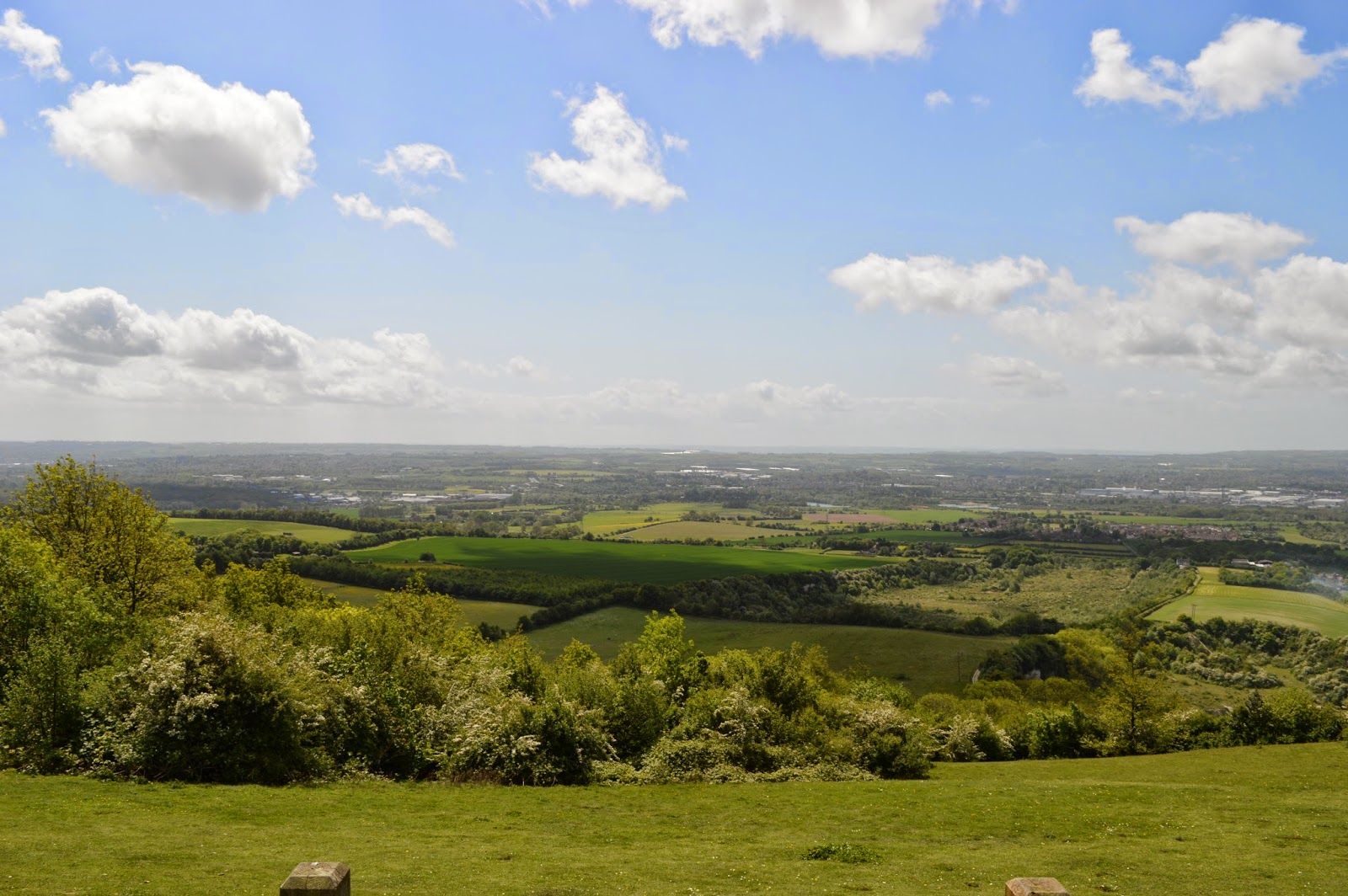
The view from the hill.

The view from the hill.


Pictures, Kent (May 2014).

If you find this post interesting please share it using the buttons below.