“Random encounters with the unusual” is a repository for the oddities that me and Mrs J have encountered on our travels, which we find interesting or amusing in some way. Have a look, maybe you will find something interesting or amusing herein.

Tuesday, 23 February 2016

Napoleon’s Penis and the most (Un) Haunted House in London

During a recent visit to London I happened across Berkeley Square in Mayfair, which during the Victorian era was believed to be home to the most haunted house in London. The property with this spooky reputation is 50 Berkeley Square. 50 Berkeley Square is a four storey town house that was built in the mid 1700s and over the years was home to a number of occupants, including one British Prime Minister.

The Prime Minister in question was The Right Honourable George Canning, who took up office on the 10th April 1827 but popped his clogs after only 4 months in office on the 8th August 1827. This untimely death means that Canning currently holds the record as Britain's shortest ever serving Prime Minister. Canning was the first person to apparently report any ghostly happenings at 50 Berkeley Square. It is said that during his time in residence that he experienced strange noises and psychic phenomena.

The most commonly told form of the ghostly legend associated with the house revolves around its attic room. Different versions of the legend state that a person (sometimes a young woman, sometimes a young man) met a tragic end (sometimes suicide, sometimes abuse) in the attic room and that they now haunt the property in the form of a brown mist or sometimes a white figure. In the legend, the ghost of 50 Berkeley Square is reported to be so terrifying that it resulted in the death of at least two people during the late 1800s, people who were brazen and foolish enough to try to spend a night in the property. One of the victims apparently died of fright, the other apparently died from a fall when trying to escape the property after seeing the terrifying ghost.

In 1937 the antiquarian book dealers Maggs Bros became the owners and residents of this notorious London address. Maggs Bros (established in 1853) is one of the longest-established antiquarian booksellers in the world, and they have made some interesting transactions over the years. The firm's record purchase occurred in 1998 when they bought a copy of the first book printed in England, William Caxton’s The Canterbury Tales, for a whooping £4,200,000. Their most notorious purchase probably occurred in 1916, when Maggs Bros bought the penis of Napoleon Bonaparte! The penis was apparently purchased from the descendants of a person who had performed Napoleon’s last rites, and had taken the opportunity to pilfer his penis. Maggs Bros sold the penis on in 1924, undoubtedly for a tidy profit.

Maggs Bros continued to operate from 50 Berkeley Square until last year (2015), when they decided to relocate their business to 46 Curzon Street. As you can see in the pictures below, when I passed the building the removals people where in attendance. During their 78 years of residency in the property Maggs Bros never had any cause to report any unusual phenomenon in the house. So this begs the question, was the house really haunted or did the ghostly presence become silent sometime before 1937?

In his article “The Most Haunted House in London” in Fortean Times Issue 335, Jan Bondeson argues the former, that this house may have never been haunted at all. Jan suggests that the house’s spooky reputation may have begun when the house was owned by the eccentric Thomas Myers Jr. Myers possibly owned the house from as early as 1859 until his death in 1874, and during his tenure it is said that he mostly lived in a single room and let the rest of the house fall into disrepair. This dilapidation of a once prestigious house led to it having the reputation as the spooky house in an otherwise respectable square. The rundown and spooky state of the house may have been all the inspiration needed for over eager ghost hunters in the early 1900s to readily declare the house haunted, possibly repeating existing tales or perhaps creating their own as they saw fit; tales that have become repeated over time until they become well known "facts".

Or perhaps the house is haunted and Maggs Bros just did not declare any strange occurrences? I guess we will have to wait and see if the new owners report any odd goings on!


50 Berkeley Square and the removals men.


A blue plaque commemorating George Canning's residency at the property.

Pictures: London (February 2015).

If you find this post interesting please share it using the buttons below.

Saturday, 13 February 2016

Seville Oddities

In two of my previous blog posts I have shared some of the interesting sights and unusual history that the city of Seville has to offer. There is the derelict remains of a 1992 vision of the future, and the tale of the Mummy of the Golden Tower.

To finish my tour of Seville here are some more of the interesting and unusual sights that can be found in the city.


Seville Cathedral - 16th Century Graffiti

On the outside wall of the cathedral, examples of Latin graffiti can be found - which looks far more stylish than its modern counterparts. The graffiti is believed to date from the 16th century and one theory is that it was written by priests in waiting, who would write on the cathedral walls once they completed their studies to become a priest. Ultimately however, nobody is really sure who is responsible for the graffiti!


Seville Cathedral - The Tomb of Christopher Columbus

One of the main attractions of the cathedral is the spectacular tomb of the famous Italian explorer Christopher Columbus. On behalf of the Spanish Monarchy, Columbus completed four voyages across the Atlantic Ocean, landing in the New World (the Bahamas) by accident in 1492 - he had been trying to find Japan. Columbus' "discovery" of the New World and his attempts to establish a permanent colony started the Spanish push to claim the Americas for the Spanish Crown, a period of colonisation which continued for around three centuries.

As every one knows, Christopher Columbus was the first European explorer to discover the Americas, well except for the Icelandic explorer Leif Ericson (970 AD - 1020 AD) who probably landed in Canada in the 11th century.

One of Columbus' other dubious achievements was that he was an early entrepreneur who spearheaded the development of the transatlantic slave trade, a diabolical practice that continued well into the 19th century.


Seville Cathedral - The Wooden Crocodile

Also inside the Cathedral those that look up may see a wooden crocodile, an elephant's tusk and what appears to be a horse's bit hanging from the ceiling.

It is said that in 1260 in an attempt to win the hand in marriage of King Alfonso X's daughter that the Sultan of Egypt showered Alfonso with a number of exotic gifts. The gifts include a crocodile, an elephant and a tame giraffe. The Sultan failed in his attempts to marry Alfonso's daughter and Alfonso was left lumbered with some rather large pets.

Apparently the animals lived out their lives in the gardens of the Royal Palace (the Alcázar) and when the crocodile died it was stuffed and put on display. The crocodile did eventually rot and so it was replaced by a wooden replica, which can be seen today. The elephant's tusk hanging from the roof of the cathedral is all that remains of the elephant, and the horse's bit was supposedly used on the giraffe and is all that remains in tribute to the giraffe.

Seville Cathedral seen from a distance.


16th century graffiti on the outside of Seville Cathedral.

The tomb of Christopher Columbus.


The wooden crocodile.

The crocodile, the elephant tusk and the giraffe's bit. 


The Purgatory Tiles

On Calle de Doña María Coronel there is a Catholic Gothic church which dates from the 1300s. This is the Church of San Pedro, and on its outer wall there is a tiled scene depicting a number of naked people surrounded by flames. These people are apparently in purgatory, waiting for their opportunity to get into heaven. Even though the flames are licking high up their bodies, the artist depicted the people as not really suffering as a result of their experience - so perhaps purgatory is not really that bad?

A legend associated with these tiles is centered around a little bird, and like most legends, is a bit silly and without any clear provenance. The artist who created the tiles painted a small bird into the scene and apparently those who spot the bird will soon get married. The bird is fairly easy to spot, if you think "outside the box".

The church of San Pedro.

The purgatory tiles.

The Missing Pissers

The "Source of Sevilla" is the name of the fountain dedicated to the city of Seville, which is located in the plaza where the Jerez Door once stood (Puerta de Jerez).

The fountain was created in 1929 by the artist Manuel Delgado Brackembury and consists of a woman sitting atop a couple of fish like creatures, which are atop some large lotus leaves, which are supported by naked children, who are in turn riding on the back of turtles (a bit Disc World?). Around the perimeter of the fountain once stood four more free standing sculptures of children. These children once held shells which gushed water, leading to them being know as "pissers".

The fountain was removed from the plaza between 1974 to 1983 whilst the city's Metro was being installed and when it was replaced, the four pissers were not returned to the fountain. It seems that during the nine years that the fountain was in storage that the pissers had disappeared. To this day, nobody seems to know the fate of the missing pissers. Perhaps they were destroyed or perhaps they were pilfered and now adorn the garden of some wealthy person?

The "Source of Sevilla".


Pictures: Seville, Spain (November 2014).

If you find this post interesting please share it using the buttons below.


Friday, 22 January 2016

Raking The Moon

As a resident of Wiltshire I was recently interested to learn that local people have in the past been called “Moonrakers”, a term that can be used in a derogatory manner.

The derogatory use of this nickname has its roots in a version of a legend that recounts how a traveller encountered some drunken Wiltshire men one moonlit night. These drunken local men were apparently trying to rake a round glowing object out of a pond. When questioned about their behaviour the rakers claimed that they were trying to retrieve  a big round cheese from the pond, which to the wise and intelligent traveller was clearly the reflection of the moon. So off the traveller goes,  having had a good chuckle about the stupidity of the locals.

The people of Wiltshire would however, point out that this nickname is derived from a different version of the legend, one that shows just how clever and cunning the locals really are.

The more readily recounted version of the legend, which predates 1787, is that on a moonlit night some local smugglers were observed by customs officers using their rakes to retrieve barrels of contraband which they had previously hidden in a pond. When challenged by the customs officers as to what they were up to, the locals played dumb by pointing to the moon’s reflection and saying that they were trying to retrieve the big round cheese! The customs men, baffled by the stupidity of these yokels, laughed at them and left. The smugglers, amused by the gullibility of the customs men, laughed at them and carried on retrieving their contraband.

This version of the legend is immortalised in the town of Devizes by a little plaque that sits near the town pond, which is known as The Crammer. The plaque reads:

The Crammer and its Legend

The origin of the Crammer is not known and neither is its name, which was probably derived from Cranmere, meaning Crane Pond. However it has often been associated with the famous Wiltshire Moonraker Legend, bestowing this nickname on the county’s inhabitants.

The story goes that some Wiltshire smugglers who had concealed kegs of brandy in the pond were observed by Excisemen in the moonlight in the act of trying to retrieve the kegs. The moon was reflected on the water and the smugglers said they were trying to rake out “Thik gurt yaller cheese.” Convulsed with Laughter, the Excisemen rode on. While the smugglers chortle “We were too vly for they. There baint no vlies on we.”

The pond is owned by Devizes Town Council.

This plaque was the gift of Mr John Drake. Mayor of Devizes in 1972/73, who was made an honorary freeman of the town in March 1996.

So which version of the legend should be believed? Well I guess that depends on whether you are a customs officer or traveller who suspects that the residents of Wiltshire lack intelligence, or if you are a resident of Wiltshire who considers themselves clever and cunning!

The Devizes town pond, known as "The Crammer".

The plaque explaining the "Moonrakers" legend.


The local "Moonrakers" public house.


Pictures: Wiltshire (January 2016).

If you find this post interesting please share it using the buttons below.

Friday, 8 January 2016

The American Connection

A couple of miles from Creech Folly in Dorset is the small hamlet of Steeple, which is home to the steeple-less Church of Saint Michael & All Angels. This quiet and remote church proudly displays the flag of Washington DC, the capital city of the United States of America. The flag was presented to the church on the 25th July 1977 by Walter E. Washington, the Mayor of Washington DC (January 1975 - January 1979). The letter accompanying the flag reads:

The Rector
Church of St. Michael & All Angels
Steeple, Dorset
England

Dear Rector,

We recently learned through Mr. George Honebon of Poole, that the Church of St. Michael & All Angels has an historic relationship with the family of George Washington, in whose honor our Nations Capital is named.

It was particularly interesting to see drawings of the stone armorial tablet depicting the Washington arms quartered with those of Lawrence. Because they are shown in our flag, the Washington arms are a very familiar sight in the District of Columbia.

Thinking that your parish might appreciate having some token of our mutal heritage, I have asked Mr. Honebon to carry with him on his return to England, this letter and the Flag of Washington, District of Columbia.

I know the citizens of our city join with me in this expression of friendship and best wishes to you and all the people of the community of Steeple, Dorset.


With warm personal regards.

Sincerely,

Walter E. Washington
Mayor
District of Columbia

The letter refers to a “stone armorial tablet” which is probably the engraved coat of arms that can be found in the stone wall of the main porch of the church. The coat of arms is a quartering (an amalgamation) of the coats of arms of the Lawrence and Washington families who were joined in 1390 when the heiress of the Washington family Agnes de Wessington married Edmund Lawrence. The Washington family’s coat of arms is the three stars atop the two stripes and it is this coat of arms that was used by George Washington (an ancestor of Agnes de Wessington) when he became the first president of the United States in 1789. This star and stripes motif was replicated in the flag of Washington DC and also was presumably the inspiration for the design of the US National flag.

A more striking example of the quartered Lawrence/Washington family coat of arms can be found painted in scarlet and white on the bosses on the ceiling of the church. It pays to look up occasionally!

The Church of Saint Michael & All Angels in Steeple.

The stone tablet in the church porch showing the coat of arms of the Lawrence/Washington family.


The flag of Washington DC in the church.

Is the flag upside down? In the coat of arms the stars sit atop the stripes!


The letter from the Mayor of Washington DC.

Looking along the church.


The painted bosses in the church roof, showing the Lawrence/Washington coat of arms.

Pictures: Dorset (May 2015).

If you find this post interesting please share it using the buttons below.

Tuesday, 8 December 2015

St Cuthbert's Cross

In “The Legend of the Durham Dun Cow” I recounted the tale of how the city of Durham was supposedly founded in 995 AD by a band of wandering monks with some help from a long-dead saint and a lost cow. The saint in question was St Cuthbert, who spent his life as a monk on the island of Lindisfarne. Cuthbert died in 687 AD and 11 years after his death, his corpse was found to be miraculously preserved. His tomb soon became a place of pilgrimage and was linked to a number of further miracles which eventually led to Cuthbert’s canonisation.

The monks of Lindisfarne left the island in 875 AD taking Cuthbert’s remains with them, having been driven out by over 80 years of ongoing Viking raids. The monks, along with Cuthbert’s remains, wandered the north of the country (predominantly Northumbria and Scotland, but also going as far south as Ripon) stopping at a number of temporary homes until 995 AD when they finally settled in what is modern day Durham.

It is because of these wanderings that a number of locations in the north of the country have become linked with the remains of St Cuthbert, and there are a number of churches in the region dedicated to the saint.

Having read about the legend of St Cuthbert and the wanderings of his remains, from their original home on the east coast of England, I was recently surprised to find a memorial to St Cuthbert on the west coast in the Lancashire seaside town of Lytham. On Church Road in front of the playing field there is a stone cross by the side of the road which bears a metal plaque. The plaque reads "According to ancient tradition the body of St Cuthbert about the year 882 once rested here."

Whether St Cuthbert’s remains actually did travel from Lindisfarne to Lytham is unclear, as all of the popular re-tellings of this tale that I have read do not seem to include a visit to the west coast. But the locals of Lytham clearly seem to believe this legend and unsurprisingly the nearby church is also dedicated to St Cuthbert!

St Cuthbert's cross in Lytham; did St Cuthbert's body once stop here in 882 AD on its journey from Lindisfarne to Durham?


Pictures: Lancashire (November 2015).

If you find this post interesting please share it using the buttons below.

Saturday, 21 November 2015

Seville’s Post-Apocalyptic Future

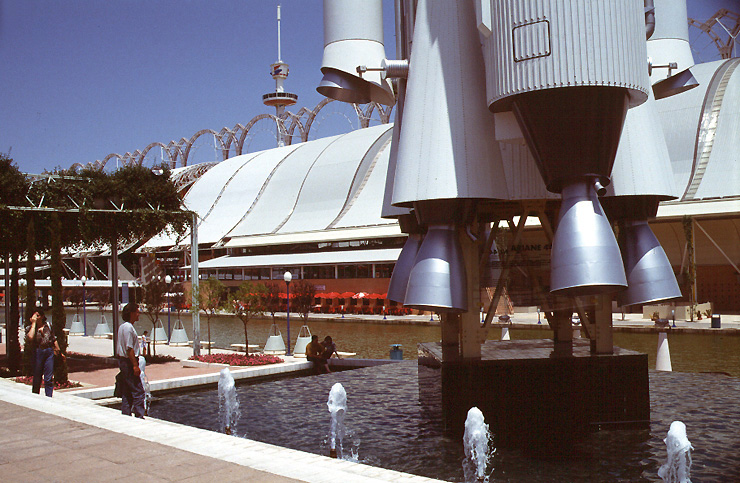
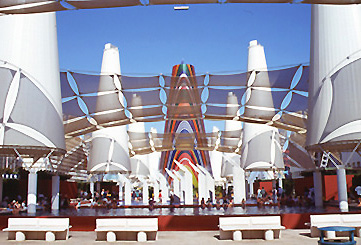
The below photos show what looks to be an abandoned post-apocalyptic science fiction landscape, with weeds and decay slowly encroaching upon a futuristic building, a communications satellite dish and a rocket. This bizarre landscape can be found on the outskirts of the Spanish city of Seville on La Isla de La Cartuja. Despite its appearance the site is not an abandoned set of a science fiction movie, but is instead part of what remains of the Universal Exposition of Seville, also known at Expo 92. Expo 92 opened in April 1992 and ran for 6 months, attracting nearly 42 million visitors. The aim of the exposition was to celebrate the modern age and offer blueprints for the future, hence the science fiction feel. Over one hundred countries were represented at the event, with some of them sponsoring massive pavilions. Some of the biggest eye-catchers included Japan’s Pavilion (at the time, the world's largest wooden structure) and the Spanish Pavilion which included a modernistic cube and a huge sphere.

The facilities and Pavilions were all planned to be temporary and demolished in the months that followed the exposition, however only some of them were. Some of the facilities and Pavilions were converted for other uses and some of them were left to decay. The post-apocalyptic science fiction landscape pictured below is what remains of the “Plaza of the Future” - a vision of the future envisaged back in 1992.

The Plaza of the Future.


The Plaza of the Future overgrown and left to decay. Views of its original grandeur can be found here, here and here


The "Seville rocket", a replica of the European Space Agency's Ariane Four launch system, which graces the Plaza of the Future.


The biosphere - this huge sphere was used to spray micro-fine jets of water to cool visitors to the exposition.


The colourful tower hiding in the background is the European Pavilion, to see it in all its glory look here.
Pictures: Seville, Spain (November 2014).

If you find this post interesting please share it using the buttons below.