“Random encounters with the unusual” is a repository for the oddities that me and Mrs J have encountered on our travels, which we find interesting or amusing in some way. Have a look, maybe you will find something interesting or amusing herein.

Showing posts with label Spain. Show all posts

Saturday, 13 February 2016

Seville Oddities

In two of my previous blog posts I have shared some of the interesting sights and unusual history that the city of Seville has to offer. There is the derelict remains of a 1992 vision of the future, and the tale of the Mummy of the Golden Tower.

To finish my tour of Seville here are some more of the interesting and unusual sights that can be found in the city.


Seville Cathedral - 16th Century Graffiti

On the outside wall of the cathedral, examples of Latin graffiti can be found - which looks far more stylish than its modern counterparts. The graffiti is believed to date from the 16th century and one theory is that it was written by priests in waiting, who would write on the cathedral walls once they completed their studies to become a priest. Ultimately however, nobody is really sure who is responsible for the graffiti!


Seville Cathedral - The Tomb of Christopher Columbus

One of the main attractions of the cathedral is the spectacular tomb of the famous Italian explorer Christopher Columbus. On behalf of the Spanish Monarchy, Columbus completed four voyages across the Atlantic Ocean, landing in the New World (the Bahamas) by accident in 1492 - he had been trying to find Japan. Columbus' "discovery" of the New World and his attempts to establish a permanent colony started the Spanish push to claim the Americas for the Spanish Crown, a period of colonisation which continued for around three centuries.

As every one knows, Christopher Columbus was the first European explorer to discover the Americas, well except for the Icelandic explorer Leif Ericson (970 AD - 1020 AD) who probably landed in Canada in the 11th century.

One of Columbus' other dubious achievements was that he was an early entrepreneur who spearheaded the development of the transatlantic slave trade, a diabolical practice that continued well into the 19th century.


Seville Cathedral - The Wooden Crocodile

Also inside the Cathedral those that look up may see a wooden crocodile, an elephant's tusk and what appears to be a horse's bit hanging from the ceiling.

It is said that in 1260 in an attempt to win the hand in marriage of King Alfonso X's daughter that the Sultan of Egypt showered Alfonso with a number of exotic gifts. The gifts include a crocodile, an elephant and a tame giraffe. The Sultan failed in his attempts to marry Alfonso's daughter and Alfonso was left lumbered with some rather large pets.

Apparently the animals lived out their lives in the gardens of the Royal Palace (the Alcázar) and when the crocodile died it was stuffed and put on display. The crocodile did eventually rot and so it was replaced by a wooden replica, which can be seen today. The elephant's tusk hanging from the roof of the cathedral is all that remains of the elephant, and the horse's bit was supposedly used on the giraffe and is all that remains in tribute to the giraffe.

Seville Cathedral seen from a distance.


16th century graffiti on the outside of Seville Cathedral.

The tomb of Christopher Columbus.


The wooden crocodile.

The crocodile, the elephant tusk and the giraffe's bit. 


The Purgatory Tiles

On Calle de Doña María Coronel there is a Catholic Gothic church which dates from the 1300s. This is the Church of San Pedro, and on its outer wall there is a tiled scene depicting a number of naked people surrounded by flames. These people are apparently in purgatory, waiting for their opportunity to get into heaven. Even though the flames are licking high up their bodies, the artist depicted the people as not really suffering as a result of their experience - so perhaps purgatory is not really that bad?

A legend associated with these tiles is centered around a little bird, and like most legends, is a bit silly and without any clear provenance. The artist who created the tiles painted a small bird into the scene and apparently those who spot the bird will soon get married. The bird is fairly easy to spot, if you think "outside the box".

The church of San Pedro.

The purgatory tiles.

The Missing Pissers

The "Source of Sevilla" is the name of the fountain dedicated to the city of Seville, which is located in the plaza where the Jerez Door once stood (Puerta de Jerez).

The fountain was created in 1929 by the artist Manuel Delgado Brackembury and consists of a woman sitting atop a couple of fish like creatures, which are atop some large lotus leaves, which are supported by naked children, who are in turn riding on the back of turtles (a bit Disc World?). Around the perimeter of the fountain once stood four more free standing sculptures of children. These children once held shells which gushed water, leading to them being know as "pissers".

The fountain was removed from the plaza between 1974 to 1983 whilst the city's Metro was being installed and when it was replaced, the four pissers were not returned to the fountain. It seems that during the nine years that the fountain was in storage that the pissers had disappeared. To this day, nobody seems to know the fate of the missing pissers. Perhaps they were destroyed or perhaps they were pilfered and now adorn the garden of some wealthy person?

The "Source of Sevilla".


Pictures: Seville, Spain (November 2014).

If you find this post interesting please share it using the buttons below.


Saturday, 21 November 2015

Seville’s Post-Apocalyptic Future

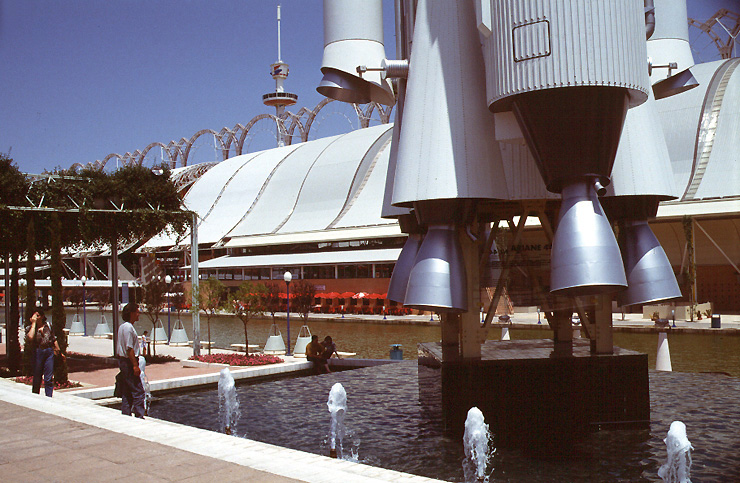
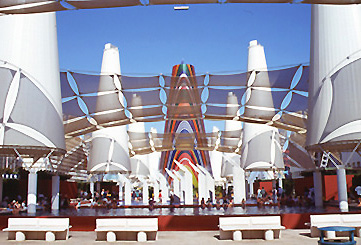
The below photos show what looks to be an abandoned post-apocalyptic science fiction landscape, with weeds and decay slowly encroaching upon a futuristic building, a communications satellite dish and a rocket. This bizarre landscape can be found on the outskirts of the Spanish city of Seville on La Isla de La Cartuja. Despite its appearance the site is not an abandoned set of a science fiction movie, but is instead part of what remains of the Universal Exposition of Seville, also known at Expo 92. Expo 92 opened in April 1992 and ran for 6 months, attracting nearly 42 million visitors. The aim of the exposition was to celebrate the modern age and offer blueprints for the future, hence the science fiction feel. Over one hundred countries were represented at the event, with some of them sponsoring massive pavilions. Some of the biggest eye-catchers included Japan’s Pavilion (at the time, the world's largest wooden structure) and the Spanish Pavilion which included a modernistic cube and a huge sphere.

The facilities and Pavilions were all planned to be temporary and demolished in the months that followed the exposition, however only some of them were. Some of the facilities and Pavilions were converted for other uses and some of them were left to decay. The post-apocalyptic science fiction landscape pictured below is what remains of the “Plaza of the Future” - a vision of the future envisaged back in 1992.

The Plaza of the Future.


The Plaza of the Future overgrown and left to decay. Views of its original grandeur can be found here, here and here. 


The "Seville rocket", a replica of the European Space Agency's Ariane Four launch system, which graces the Plaza of the Future.


The biosphere - this huge sphere was used to spray micro-fine jets of water to cool visitors to the exposition.


The colourful tower hiding in the background is the European Pavilion, to see it in all its glory look here.
Pictures: Seville, Spain (November 2014).

If you find this post interesting please share it using the buttons below.


Friday, 28 November 2014

The Mummy of the Golden Tower

The pictures below show the Torre del Oro (the Gold Tower) which was a military watchtower in Seville constructed in the early 13th century. The tower sits alongside the Canal de Alfonso XIII, and was originally intended to guard the waterway access into Seville and also acted as a prison. The tower is known as the gold tower due to its colour. Today the tower is home to Seville’s Maritime Museum.

The Torre del Oro is linked to a tragic legend of a women who was pestered by a king into a horrific act of self-mutilation. The woman in question was Maria Fernandez Coronel who was born in 1334 and is reported to have grown into an immensely beautiful woman over the years.

King Peter I (Don Pedro I) who was the king of Castile and León from 1350 to 1369 met Maria (who was married to Don Juan de la Cerda, the lord of Gibraleon) and he was instantly besotted by her beauty. It is said that King Peter was so besotted that he commenced a campaign of harassment against Maria, constantly pestering her, trying to get her to give herself to him. King Peter’s campaign was so intense that Maria opted to withdraw from social life, hoping that being out of sight would help to remove her from King Peter’s mind.

In 1366 the Castilian Civil War began, which saw King Peter in conflict with his illegitimate brother, Henry of Trastámara. During this civil war Maria’s husband Don Juan de la Cerda was in the service of the king’s brother and had the bad luck of being captured by the king’s men. Hearing of her husband’s capture Maria visited King Peter to plead for her husband’s life, but it was too late as he had already been executed at the Torre del Oro. The execution of her husband and the subsequent seizure of all the family’s assets left Maria destitute and she eventually sought refuge at a convent.

Coming to the king’s attention again meant that Maria was again subject to harassment by the king who remained insistent that she should give herself to him. Eventually the king sent his men to the convent to find Maria and bring her to him, but she managed to elude their searches by being temporarily buried alive. Displeased with his men’s failure to find Maria, the king eventually went to the convent himself in order to capture Maria, and he eventually cornered her. Finally having had enough of the king’s advances it is said that Maria picked up a pan of boiling olive oil and poured it over her face to remove her beautiful looks and dissuade the king in his advances. Unsurprisingly Maria was severely disfigured by this act of self mutilation.

After this tragic event it is said that King Peter was so remorseful for his actions that Maria’s family assets were returned to her, and these assets enabled her to found the Convent of St. Agnes in Seville. Maria eventually died on December 2nd 1411 at the ripe old age of 77. In the mid sixteenth century construction work uncovered Maria’s tomb, and her body was found to be very well preserved, with her characteristic burns still visible. Her body was subsequently placed into a glass box and today is still preserved in the Convent of St. Agnes (Convento de Santa Inés on Calle Dona Maria Coronel), and it can be viewed on the anniversary of her death each year (December 2nd). Some pictures of her persevered body can be found on this blog.

King Peter met a suitably nasty end for a sex pest; in 1369 he was apparently stabbed in the face by his illegitimate brother Henry of Trastámara.


Torre del Oro (the Gold Tower).


The Canal de Alfonso XIII.

Pictures: Seville, Spain (November 2014).

If you find this post interesting please share it using the buttons below.


Wednesday, 19 November 2014

The Home of the Spanish Smurfs

The Spanish region of Andalusia is known for its white towns and villages,  where all of the buildings are uniformly whitewashed making the settlements stand out against the earthy colours of the countryside. Not all of these settlements are white however, one town known as Júzcar is painted blue, Smurf-blue!

In 2011 this small and remote Spanish town was selected as the location for the worldwide premiere of the 2011 movie “The Smurfs”, which was held on June 16, 2011. Prior to the screening of the premiere Sony Pictures arranged to have the town painted Smurf-blue. It is reported that circa 4,000 litres of paint were used in this undertaking, which saw the entire town including the church and its gravestones painted. This transformation of the town from a traditional whitewashed settlement to a blue haven for Smurfs drastically increased the number of visitors to the town, and as a result of this the inhabitants have kept the new colour scheme to this day.

These little blue creatures, which were first created by Belgian cartoonist Peyo (Pierre Culliford) in 1958 are not just responsible for turning a Spanish town blue. According to the "Topless Robot" website it seems that the Smurfs may have inspired modern day Zombie fiction with their 1963 storyline "The Purple Smurf". The same website also recounts that Smurf figurines may have been responsible for creating a lead poisoning scare in the UK in the 1970s.

For those who care to investigate I am sure there are also many other Fortean themes lurking in the long history of theses little blue creatures.

Looking across the roof tops.


Smurf murals adorn the town.


Pictures: Júzcar, Spain (November 2014).

If you find this post interesting please share it using the buttons below.